

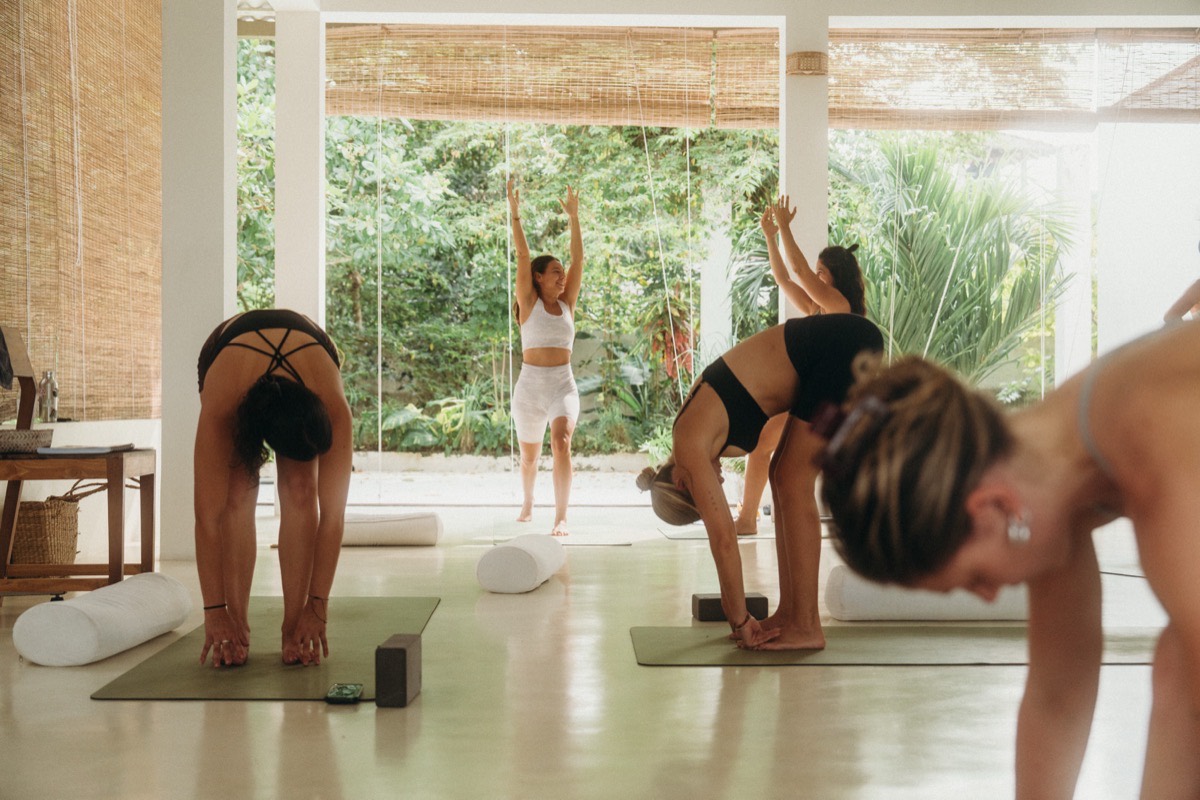
- Hatha yoga vs vinyasa comes down to one core idea: hatha classes usually hold each posture for several breaths, while vinyasa links postures into a continuous, flowing sequence.
- In the modern studio sense, hatha is the slower, more static style, you set up a pose, hold it, then move on. Vinyasa is the dynamic, flowing style, with movement and breath moving together from shape to shape.
- Confusingly, "hatha" is also an umbrella term for nearly all physical (postural) yoga. In that older sense, vinyasa is technically a type of hatha yoga.
- Historically, hatha yoga is roughly 900 years old and rooted in the Hatha Yoga Pradipika (~500 years ago). Vinyasa is a 20th-century evolution of Ashtanga, traced to Krishnamacharya and K. Pattabhi Jois.
I've taught yoga for over a decade, and at Lanka Yoga we run both yoga teacher trainings, a Hatha one and a Vinyasa one. So when people ask me about hatha yoga vs vinyasa, I'm not defending one team over the other. This guide is for anyone standing outside a studio, looking at a timetable, wondering which class to walk into. Let's clear it up in plain language.
Hatha vs Vinyasa at a Glance
If you only read one thing, read this. Here's hatha vs vinyasa side by side.
| Hatha Yoga | Vinyasa Yoga | |
|---|---|---|
| Pace | Slower, deliberate | Faster, continuous flow |
| How poses work | Hold each posture for several breaths | Link postures into a moving sequence |
| Breath | Steady breathing while holding | Movement and breath move together |
| Feel | Grounded, precise, meditative | Dynamic, warming, athletic |
| Sequence | Often the same familiar postures | Varies class to class; no fixed order |
| Best for | Beginners, alignment, slowing down | Building heat, stamina, flow |
| Typical class label | "Hatha," "gentle," "foundations" | "Vinyasa," "flow," "power" |
Keep in mind these are tendencies, not rules. A "hatha" class in one studio can be more vigorous than a "slow flow" vinyasa in another. The label is a hint, not a guarantee.
What Is Hatha Yoga?
Here's where it gets interesting, because "hatha" means two different things depending on who's talking.
In the traditional sense, hatha yoga is an old, physical branch of yoga. The word hatha translates as "with effort" or "with discomfort". It can be traced back roughly 900 years to what is now Northern India, and about 500 years ago the Hatha Yoga Pradipika was written as a practical manual for it, covering everything from posture and breathwork to diet and sleep. Tellingly, that text describes only around 15 (mostly seated) postures, a reminder that classical hatha was far less about athletic shapes than modern yoga is. That gap between the old practice and the new one runs through everything, and our guide to what yoga is traces it end to end.
In the modern studio sense, when a timetable says "Hatha," it usually means a slower, more static class. You move into a posture, hold it for several breaths while you find your alignment and steady your breathing, then release and set up the next one. There's time to understand each shape. This is the sense most people mean in a hatha vs vinyasa conversation, and it's the one I'll use for the comparisons below. If you want to see how we teach it, here's our Hatha yoga teacher training.
What Is Vinyasa Yoga?
Vinyasa yoga is a style in which you move continuously from one posture to the next, so the practice flows rather than stopping and starting at every pose. Instead of holding a shape and then building the next one, you link the postures into a smooth, connected sequence, with movement and breath moving together as you go. That flowing quality is the whole point, it's why vinyasa is also called "flow yoga."
Vinyasa is a modern practice with deep roots. It grew out of Ashtanga Vinyasa Yoga, developed by K. Pattabhi Jois, a student of Tirumalai Krishnamacharya, often called the father of modern postural yoga. Ashtanga's set sequences were physically demanding, so teachers began softening them: adding warm-ups, adjusting postures, and freeing the sequence from one fixed order. That more flexible, creative version became vinyasa. If you'd like the full story, I've written a deeper piece on what vinyasa yoga is.
One consequence matters here: unlike Ashtanga, vinyasa has no single guru, no central guidebook, and no governing body. That freedom keeps it fresh, but it also means quality varies widely from class to class. (Worth knowing: the studio style called Ashtanga borrowed its name from ashtanga, the eight-limbed path of yoga, but the two aren't the same thing.)
Hatha vs Vinyasa: The Key Differences
At a glance the two can look similar: same postures, same mats, same studio. The differences are in how you move.
1. Pace
This is the big one. Hatha is slower; you spend real time in each posture. Vinyasa is continuous; you're almost always transitioning. If you like a calm, unhurried rhythm, hatha will feel more natural. If you get restless holding still, vinyasa's momentum will suit you better.
2. Breath and movement
In vinyasa, movement and breath move together. Many teachers cue the breath to lead ("inhale, reach up… exhale, fold"), though we teach it the other way round, the movement leads and the breath follows naturally. In hatha, you breathe steadily while holding a pose rather than using each breath to drive a transition. Both are breath-aware; vinyasa just keeps breath and motion moving as one.
3. Sequencing
Hatha classes tend to revisit a familiar set of postures, so you can build confidence through repetition. Vinyasa varies its sequences, so no two classes are quite the same. That makes vinyasa more creative, but also less predictable.
4. Intensity
Because you're moving the whole time, vinyasa usually builds more heat and gets your heart rate up, closer to a light cardiovascular workout. Hatha's held postures put the emphasis on stability, alignment and stretch. Neither is automatically "harder"; a deep 90-second hold can be every bit as demanding as a flow.
My honest take: speed isn't the same as benefit. A fast, pushy vinyasa can raise stress and encourage overstretching into range you can't actually control, while a mindful hatha hold can be deeply restorative. How you move matters far more than which label is on the class.
"But Isn't Vinyasa a Type of Hatha?"
Yes, and this is where a lot of the confusion online comes from. Because "hatha" is the umbrella term for essentially all physical, posture-based yoga, vinyasa technically sits underneath it. In that framing, hatha is the whole family and vinyasa is one energetic member of it.
So both statements are true at once:
- In the studio: "hatha" = the slow, held-posture class, and it's a peer of vinyasa.
- In the tradition: "hatha" = all postural yoga, and vinyasa is a subtype of it.
When you compare hatha vs vinyasa yoga on a class timetable, you're using the first meaning. That's the practical one, so don't let the technicality trip you up.
What Are the Benefits of Each?
Yoga isn't magic, and the benefits depend heavily on how a class is taught. That said, here's an honest look at what each style tends to offer.
Hatha yoga benefits
- Alignment and body awareness, since you have time in each shape
- Flexibility and joint range, from longer, patient holds
- Stress reduction and a calmer nervous system, for the reasons set out in our guide to shifting out of fight-or-flight
- A gentle, accessible entry point for beginners
Vinyasa yoga benefits
- Stamina and usable, moving strength
- Circulation and a light cardiovascular effect
- A "moving meditation" quality when practised slowly and mindfully
- Movement and breath moving together
No single style is complete on its own. I tell every student the same thing: mix in some strength work and some slow, restful movement too. A balanced body comes from variety, not repetition.
Which One Is Right for You?
Rather than "which is better," ask "which fits what I want today?"
- Choose hatha if you're brand new, recovering your confidence, love detail and alignment, or simply want to slow down and de-stress.
- Choose vinyasa if you enjoy moving, want to build heat and stamina, get bored holding still, or like variety from class to class.
- Choose both if you're like most long-term practitioners, hatha to refine and restore, vinyasa to move and energise.
Whatever you pick, the teacher matters more than the label, which is the argument we make in how to get better at yoga. Start with a class labelled for your level. "Vinyasa" in particular ranges from gentle to very advanced, so look for "beginner," "slow flow," or "foundations," and tell the teacher you're new. And if you want to compare vinyasa with the slowest, stillest style of all, see our yin yoga vs vinyasa guide.
Quick-Choose Checklist
Save this and answer honestly:
- I prefer a calm, unhurried pace → Hatha
- I get restless holding still → Vinyasa
- I want time to learn alignment → Hatha
- I want to build heat and break a sweat → Vinyasa
- I'm completely new to yoga → Hatha (or a beginner slow flow)
- I like variety and creativity in class → Vinyasa
- I want to reduce stress and slow down → Hatha
Mostly ticking one column? Start there. Ticking both? Do both, that's the honest answer for most people.
Going Deeper Into Both
For most people, the hatha vs vinyasa question ends at "which class do I take this week?" But at some point you might start wondering why these styles work, how the breath, the anatomy and the sequencing actually fit together. That curiosity is often the first step toward becoming a yoga teacher. It's also where the philosophy starts to matter, because both hatha and vinyasa sit inside a much older framework: the eight limbs of yoga, where posture is only the third of eight.
FAQs: Hatha Yoga vs Vinyasa
What is the main difference between hatha and vinyasa yoga?
The main difference is pace and structure. Hatha yoga holds each posture for several breaths in a slower, more static class, while vinyasa links postures into a continuous, flowing sequence with movement and breath moving together. Hatha feels grounded and precise; vinyasa feels dynamic and warming.
Is vinyasa a type of hatha yoga?
Technically, yes. "Hatha" is the umbrella term for nearly all physical, posture-based yoga, so vinyasa sits underneath it. But on a studio timetable, "hatha" means the slower, held-posture style, and there it's treated as a separate class from vinyasa.
Which is harder, hatha or vinyasa?
Vinyasa usually feels more physically demanding because you move continuously and build heat, closer to a light cardio workout. But hatha isn't easy, long, deliberate holds test your stability and focus. Difficulty depends more on the teacher and level than on the style itself.
Is hatha or vinyasa better for beginners?
Hatha is often the gentler starting point, because holding postures gives beginners time to learn alignment and breathe steadily. That said, a beginner-labelled "slow flow" vinyasa can be just as accessible. Whichever you choose, pick a class marked for beginners and tell the teacher you're new.
Which burns more calories, hatha or vinyasa?
Vinyasa generally burns more, since continuous movement raises your heart rate more than held postures do. But yoga of any style is best seen as one part of a balanced, active routine rather than a calorie-burning quick fix.
Can I do both hatha and vinyasa?
Absolutely, and most experienced practitioners do. Hatha refines your alignment and calms the nervous system, while vinyasa builds stamina and flow. Alternating them gives you a more balanced, sustainable practice than sticking to one.
Final Thoughts
Strip away the jargon and hatha yoga vs vinyasa is really a question of tempo: hatha holds, vinyasa flows. One isn't superior to the other, they're two doors into the same room. What keeps me teaching both is that they meet different needs, on different days, for different bodies.
So don't overthink the label. Roll out a mat, try a slow hatha class and a beginner vinyasa flow, and notice which one leaves you feeling more like yourself. That's the only comparison that really counts. A week of both back to back settles it faster than months of single classes, which is how our yoga retreats in Sri Lanka are structured: dynamic mornings, restorative evenings.