
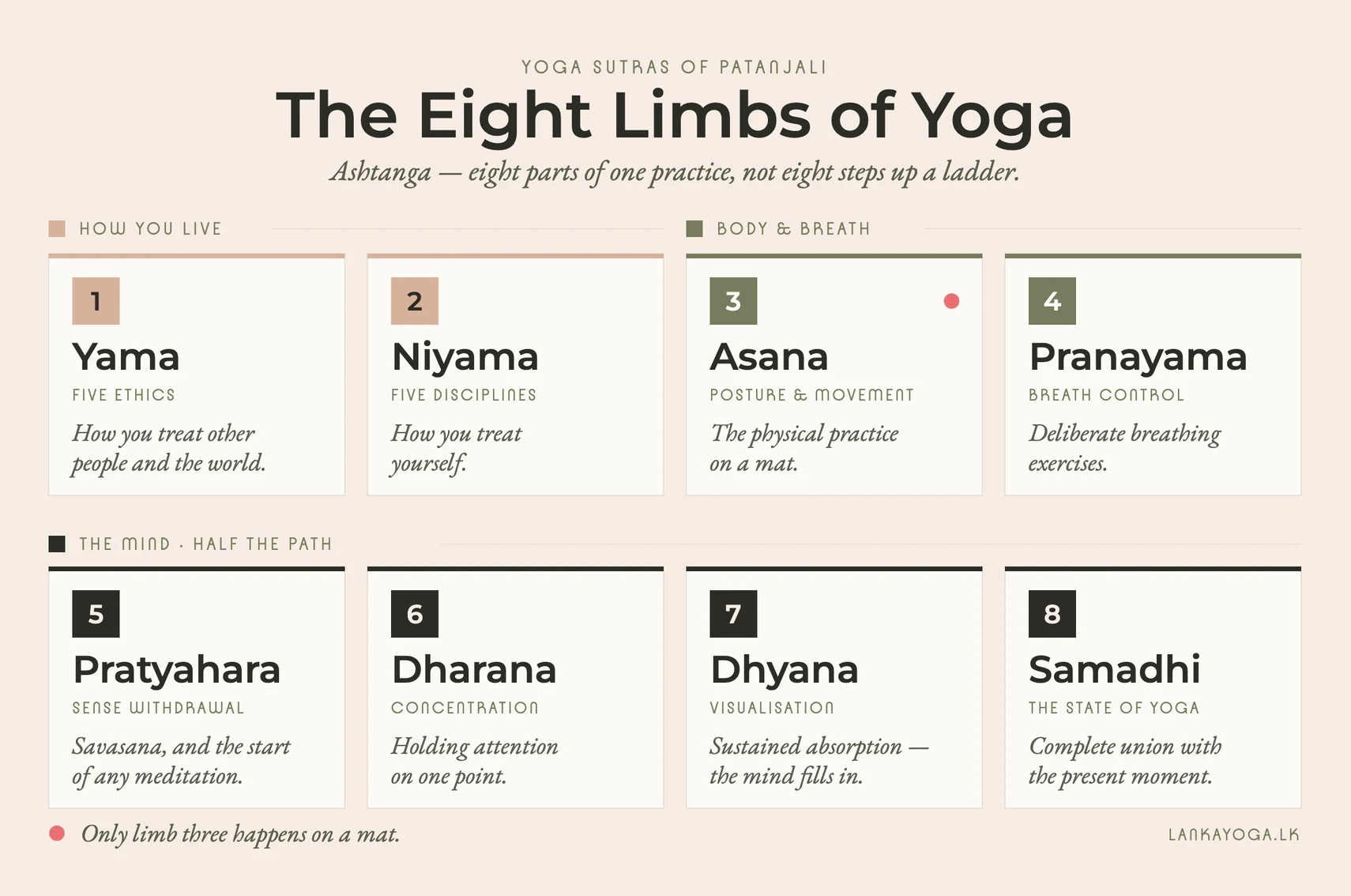
- The eight limbs of yoga are Patanjali's eight components of a complete yoga practice: yama, niyama, asana, pranayama, pratyahara, dharana, dhyana and samadhi.
- They come from the Yoga Sutras, a 2,500-year-old Sanskrit text of 196 short verses. The 8 limb path sits in its second chapter.
- "Ashtanga" literally means "eight limbs." It is not the same thing as the Ashtanga Vinyasa style you see on a studio timetable, and confusing the two is the single most common mix-up we meet on training.
- Asana, the physical postures, is only limb three. Roughly a quarter of the path is about how you behave when nobody is watching, and half of it is about the mind.
- Read the limbs as a set of skills that support each other rather than a ladder you climb once, and the whole thing becomes usable in an ordinary week.
I've taught yoga for over a decade, and on every 200-hour training we run here at Lanka Yoga there is a moment in the philosophy module where the room goes quiet. It's usually when someone realises that the thing they have been calling "yoga" for the last five years is one eighth of what Patanjali was actually describing.
That's not meant as a telling-off. Asana is a wonderful doorway, and it's the one nearly all of us walk through. But if you have ever wondered what the other seven eighths are, this is the honest, teacher's-eye version of the 8 limbs of yoga explained in plain language, drawn from the philosophy chapter of the manual we hand our own trainees.
What Are the Eight Limbs of Yoga?
The eight limbs of yoga are the eight components of yoga practice set out by the sage Patanjali in the Yoga Sutras: yama (ethics), niyama (personal disciplines), asana (posture and movement), pranayama (breath control), pratyahara (withdrawal of the senses), dharana (concentration), dhyana (visualisation, usually translated as meditation) and samadhi (the state of yoga itself). Together they are called ashtanga, which translates from Sanskrit as "eight limbs."
Patanjali laid them out in the second chapter of his text as a structured approach to the whole of yoga. Within that framework he establishes three things: behavioural guidelines for how you live, parameters for the practice itself, and the progression toward meditation. The word "limbs" is doing real work here, incidentally. They're limbs, not steps. Parts of one body, each supporting the others.
The 8 Limbs of Yoga at a Glance
| # | Limb | Plain English | What it looks like in practice |
|---|---|---|---|
| 1 | Yama | Five ethics | How you treat other people and the world |
| 2 | Niyama | Five personal disciplines | How you treat yourself |
| 3 | Asana | Posture and movement | The physical practice on a mat |
| 4 | Pranayama | Breath control | Deliberate breathing exercises |
| 5 | Pratyahara | Withdrawal of the senses | Savasana; the settling at the start of meditation |
| 6 | Dharana | Intense concentration | Holding attention on one point |
| 7 | Dhyana | Visualisation, meditation | Sustained absorption, where the mind fills in |
| 8 | Samadhi | The state of yoga | Complete union with the present moment |
Notice the shape of it. The first two limbs never touch a mat. The third and fourth are the body and the breath. The last four are all mind. Modern yoga has, more or less, taken limb three and built a global industry on it.
Where the 8 Limb Path Comes From
The eight limbs live in the Yoga Sutras of Patanjali, a 2,500-year-old Sanskrit text attributed to a writer and sage of that name. Before it, yoga was taught through myth and story. The Sutras were the first attempt to simplify and define the thing clearly, and to offer a guide for how to work toward it. The longer story, from the Vedas through to the modern studio class, is the subject of our guide to what yoga is.
The text is 196 sutras (short verses, rarely longer than a sentence) arranged in four chapters:
- Samadhi pada: the definition of yoga and the mystery of the mind
- Sadhana pada: the practice of yoga
- Vibhuti pada: the supernatural
- Kaivalya pada: non-duality
The 8 limb path appears in chapter two, the practical one. Two sutras from chapter one set the scene for everything that follows.
Sutra 1.1: "Yoga is now." Yoga exists in the present moment, not the future or the past. It contrasts sharply with how the mind usually behaves, dancing between old problems and future worries. Plenty of contemporary teachers consider this the single most important idea in all of yoga philosophy.
Sutra 1.2: "Yoga is the cessation of the fluctuations of consciousness." Yoga is experienced when thoughts and emotional disturbances quieten. Not just anxious thoughts, either — the sutra encourages tempering the extreme highs as well as the lows.
Hold those two next to the eight limbs and the logic snaps into focus. If yoga is a quiet mind in the present moment, then the limbs are simply the eight things that make that state more likely.
Wait, Isn't Ashtanga a Style of Yoga?
This is the mix-up I untangle most often, so let's deal with it before going further.
Ashtanga, in Patanjali's sense, means the eight limbs. It's a philosophical framework roughly 2,500 years old, and it contains almost no postures at all.
Ashtanga Vinyasa is a modern physical style developed by K. Pattabhi Jois, a student of Krishnamacharya, in twentieth-century Mysore. It's an intense, physically demanding practice with a set sequence repeated daily, traditionally practised "Mysore style" with students working independently while the teacher adjusts. It borrowed the name; it isn't the same thing.
So when someone says "I do Ashtanga," they almost always mean the sweaty morning sequence, not the eightfold path. And when a philosophy teacher says "Ashtanga yoga," they almost always mean the path. If you'd like the wider family tree, we have written it up in our guide to what vinyasa yoga is.
The 8 Limbs of Yoga Explained, One by One
1. Yama: The Five Ethics
The yamas are ethical guidelines for how you meet other people and the world. Along with the niyamas, they are the foundation of a yogic lifestyle, and Patanjali put them first for a reason: he didn't think a person could concentrate their way to peace while behaving badly.
- Ahimsa (non-violence): practising kindness and non-harming toward all living beings (including yourself) in thought, word and action.
- Satya (truthfulness): being honest and authentic in thoughts, words and actions, while staying mindful of how your truth lands on other people.
- Asteya (non-stealing): avoiding theft in all its forms, physical, mental or emotional, by respecting others' belongings, ideas and time. Asteya also asks for generosity: giving freely, without expectation.
- Brahmacharya (moderation): the proper direction of energy. Moderation and mindfulness in all areas of life, particularly around sensual and material pleasure, so that you avoid excess.
- Aparigraha (non-attachment): letting go of possessiveness and non-attachment to possessions, relationships and outcomes. Simplicity, and generosity again.
Two of those deserve a note. Asteya covers stealing someone's time, which is worth sitting with if you're habitually forty minutes late. And ahimsa includes yourself, which most of us find far harder than being kind to strangers.
2. Niyama: The Five Personal Disciplines
If the yamas are outward-facing, the niyamas turn inward.
- Saucha (purity): cleanliness inside and out, caring for your body, mind and environment with some attention.
- Santosha (contentment): developing the power to choose contentment with what you have, finding some peace in the present moment regardless of circumstances.
- Tapas (self-discipline): discipline, commitment and perseverance. Meeting challenge as an opportunity rather than an insult.
- Svadhyaya (self-study): regular self-reflection and study, for the purpose of deepening self-awareness.
- Ishvara pranidhana (surrender): letting go and accepting what is, while possibly connecting with your own idea of a higher power, acknowledging a force greater than yourself.
Santosha is the one that reliably causes an argument on training, because people hear it as "give up on wanting things." It isn't. It's the ability to feel content while you carry on growing, which is a skill, not a resignation. And note how carefully Patanjali leaves the door open on surrender: your idea of a higher power. The eight limbs don't require you to sign up to anything.
3. Asana: Posture and Movement
The original meaning of asana was simply "seat". A sitting position for meditation. Today it means the physical postures and poses that most of the world now calls yoga, practised in gyms and studios everywhere, often with the spiritual roots quietly filed off.
Even so, asana still does exactly what it was meant to. It aligns the body, focuses the mind and regulates the breath, and it builds strength, flexibility, mobility and a bit of inner peace along the way — though flexibility and mobility are not the same thing, and only one of them is really yours. Originally the goal was never fitness; it was self-realisation. According to the scriptures, mastery of asana is considered essential before you can make much progress in the other limbs.
Two sutras aim straight at how to practise it. Sutra 2.46 asks for the balance between effort and ease. Sutra 1.47 goes further: perfection in asana arrives when effort transforms into effortlessness. That, for what it is worth, is a far better standard than getting your head to your knee, and it is the standard we argue for in how to get better at yoga.
My honest take, after years of watching people practise: this is the limb most likely to be practised in a way that contradicts limb one. Straining into a shape because the person on the next mat can do it isn't ahimsa. Whether you are drawn to a flowing vinyasa practice or a slower hatha class, how you move matters far more than what the timetable calls it.
4. Pranayama: Breath Control
Pranayama is the conscious regulation of the breath. The word comes from prana (life force, vital energy) and ayama (extension or control).
The techniques work with inhalation (puraka), exhalation (rechaka) and breath retention (kumbhaka), in different patterns and durations. The aim is to optimise the flow of energy through the body, and the by-products are worth having on their own: lung capacity, breath control, mental clarity, inner peace. Regular practice measurably affects your physiology, particularly by reducing stress and calming the fight-or-flight response.
One belief I will happily argue with anyone about: more breath is not better breath. During asana we teach students to breathe naturally, and in dedicated pranayama we generally work toward breathing slightly less than normal rather than more. Big, forceful, artificially deep breathing is a common habit in modern classes and it doesn't do what people think it does. If you want the physiology behind that claim, it's the first practice in our guide to how to calm your nervous system.
5. Pratyahara: Withdrawal of the Senses
Pratyahara is experiencing, observing and eventually controlling the senses (sight, smell, sound, taste and touch). It's the hinge of the 8 limb path, the point where the practice turns from outside to inside.
You start by simply becoming aware of your senses: what you can see, hear, smell, taste and feel right now. Once that awareness is established, there are two directions to go. You can let the sensory experience recede into the background, which is withdrawal in the classic sense. Or you can refine and gain some control over the sensory experience, directing attention deliberately.
The most obvious example is savasana with a guided body-awareness relaxation, and it is also what the first few minutes of any meditation are really doing. But pratyahara isn't restricted to lying down. It can be practised to some degree in any pose or movement.
6. Dharana: Concentration
Dharana is intense, focused attention: concentrating the mind on a single point or object to develop steadiness. The object is up to you and can vary from a mantra, the breath, something visual or single thought. The work is sustaining attention on it as everything in your head tries to wander off.
Practised consistently, dharana builds one-pointed concentration, which is what makes the next limb possible at all. It's also, incidentally, the limb with the most obvious payoff in ordinary modern life. Attention is the resource everything is currently competing for.
7. Dhyana: Visualisation
Once you can hold focus on a single point, the next layer of meditation opens. Dhyana is usually translated as "meditation," but our manual translates it as visualisation, which describes the experience more accurately: you focus on an object long enough that the mind begins to fill in the gaps with visualisations or sensations. People often describe it as transcendental, and the comparisons they reach for range from meeting god to the effects of certain drugs.
Dhyana can involve a continuous flow of thought, imagery or bodily sensation, and it fosters a deep connection with the present moment. Practise it regularly and the hope is that you begin to transcend the fluctuations of the mind.
8. Samadhi: The State of Yoga
Samadhi is usually described as the ultimate goal of yoga: enlightenment, the end of suffering. That framing is true and also fairly unhelpful, because it makes samadhi sound like a prize awarded to monks.
A simpler way to think about it is as the peak experience of yoga. A moment of feeling completely united with the present, living the yamas and niyamas, with genuine command of your breath, your nervous system and your mind. Crucially, it isn't something you do. It's something that may happen when everything else falls into place. It can last a second or considerably longer, and it can turn up during yoga, during meditation, or while you are doing something you love. Plenty of people describe something very like samadhi in their favourite activity without ever calling it that.
Or, more modestly: samadhi is the peaceful gap between two thoughts. Most of us have already been there. We just didn't stay long.
Is the 8 Limb Path a Ladder or a Web?
Almost every article you'll read implies a ladder: sort out your ethics, then your postures, then your breath, then work up to bliss. Patanjali did also present them in an order. You'll struggle to concentrate on a mantra in a body that can't sit still, and you'll struggle to sit still in a life you feel guilty about.
But in over a decade of practice and teaching I've never met a person who climbed it that way. Nobody completes the yamas and graduates. What actually happens is messier and more encouraging: your asana practice teaches you something about tapas, which changes how you handle a difficult week, which makes ten minutes of concentration slightly less impossible. The limbs feed each other in every direction.
How to Practise the Eight Limbs in an Ordinary Week
Here is the version I give trainees who want something concrete rather than inspiring.
- Yama: choose one and start with asteya and other people's time. Simply observe yourself for seven days.
- Niyama: commit to one small daily thing and do it whether or not you feel like it (tapas).
- Asana: practise three or four times, slowly enough to notice what you're doing. Effort and ease, per sutra 2.46.
- Pranayama: two minutes of slightly longer exhalations, ideally before you sleep.
- Pratyahara: take savasana seriously, or spend five minutes deliberately listening to every sound you can hear.
- Dharana: five minutes of attention on the breath, returning each time you drift. The returning is the exercise.
- Dhyana: don't chase it. It shows up occasionally when dharana becomes comfortable.
- Samadhi: likewise. Your job is the other seven.
Where the Eight Limbs Fit into Teacher Training
Philosophy is not a bolt-on module for us. Our 200-hour yoga teacher training in Sri Lanka covers the eight limbs of yoga and what they actually mean off the mat, alongside anatomy, teaching methodology, pranayama and meditation.
It's also, quietly, the part graduates tell us changed the most. You arrive able to demonstrate a posture. You leave with a framework for why any of it matters. The inner limbs in particular — pratyahara, dharana, dhyana — need conditions ordinary weeks don't give you, which is much of the point of our retreats in Sri Lanka. If that's the direction you're heading, our guide on how to become a yoga teacher covers the practical route.
FAQs: The Eight Limbs of Yoga
What are the eight limbs of yoga?
The eight limbs of yoga are yama (ethics), niyama (personal disciplines), asana (posture), pranayama (breath control), pratyahara (withdrawal of the senses), dharana (concentration), dhyana (meditation) and samadhi (the state of yoga). They were set out by Patanjali in the Yoga Sutras as the components of a complete yoga practice, and together they are known as ashtanga, meaning "eight limbs."
What are the 5 yamas and 5 niyamas?
The five yamas are ahimsa (non-violence), satya (truthfulness), asteya (non-stealing), brahmacharya (moderation) and aparigraha (non-attachment). The five niyamas are saucha (purity), santosha (contentment), tapas (self-discipline), svadhyaya (self-study) and ishvara pranidhana (surrender). The yamas govern how you treat others; the niyamas govern how you treat yourself.
Is Ashtanga yoga the same as the eight limbs of yoga?
Not quite. "Ashtanga" literally means "eight limbs" in Sanskrit and refers to Patanjali's path. Ashtanga Vinyasa is a modern physical style developed by K. Pattabhi Jois with a fixed daily sequence. The style borrowed the name, but the two are separate things.
What is the ultimate goal of the eight limbs of yoga?
Samadhi, the eighth limb: a state of complete union with the present moment, often described as enlightenment or the end of suffering. It isn't a technique you perform but a state that can arise when the other limbs fall into place, and it can be momentary rather than permanent.
Can you practise the eight limbs of yoga if you are not religious?
Yes. Seven of the eight limbs are ethical, physical or mental disciplines with no theology attached. Even the eighth, and the niyama of surrender, are framed openly. Patanjali refers to your own idea of a higher power, and many practitioners read it simply as acceptance of what is.
Final Thoughts
Ask what the eight limbs of yoga are and you get a list. Live with them for a while and you get something more useful: a reminder that yoga was never only a physical practice, and that the difficult limbs are usually the ones off the mat.