
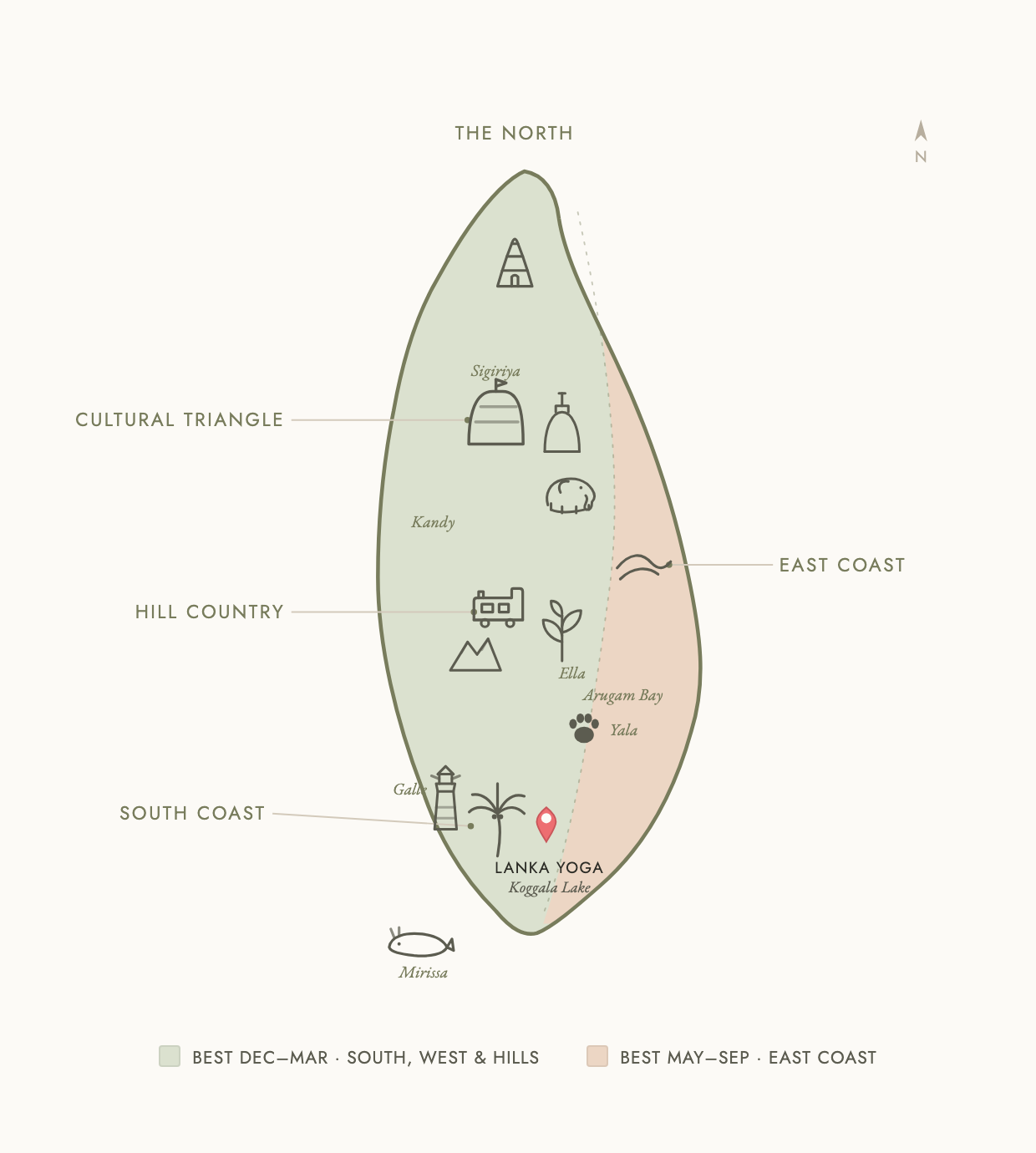
- The four regions worth your time: the Cultural Triangle, the hill country, the south coast, and the national parks.
- Best time to visit: December to March for the south and west coast, May to September for the east.
- Ten days is enough for a strong first trip; two to three weeks lets you slow down.
- Skip the traps with local knowledge: the PickMe app for tuk tuks, Koggala Lake by boat, and the beaches most guides miss.
- Every place below links to Google Maps so you can drop it straight into your route.
Sri Lanka is small enough to cross in a day and varied enough to fill a lifetime. In one week you can climb an ancient rock fortress, ride a train through tea hills, watch blue whales, and fall asleep to the sound of the ocean. This guide covers the best things to do in Sri Lanka, written from the south coast where we live and run our retreats, so you get a real sense of what is worth your time and when to go.
It is written for first-time visitors and returning travellers planning a one to three week trip who want the highlights without the touristic fluff.
When to visit Sri Lanka
Sri Lanka has two monsoons that hit opposite coasts at opposite times, which is good news: some part of the island is always in season. The south and west coasts and the hill country are driest and sunniest from December to March. The east coast, including Arugam Bay and Trincomalee, comes into its own from May to September. The central Cultural Triangle is warm and doable most of the year, though it is hot by midday, so sightsee early. For one window that covers ancient sites, hill country and south-coast beaches, aim for January to March.
Start in the Cultural Triangle
The centre of the island holds Sri Lanka's oldest history, and it is where most itineraries begin.
Climb Sigiriya at sunrise (and get the better view from Pidurangala)
Climb Sigiriya, a 200-metre column of rock crowned by a 5th-century royal palace, reached by around 1,200 steps past ancient frescoes and a giant pair of carved lion's paws. Arrive at 7am opening to beat the heat and the crowds. Here is the local trick: the best photo of Sigiriya is from the top of Pidurangala Rock next door, a rougher scramble that costs a fraction of the price. Do Pidurangala for sunrise, Sigiriya after.
Step inside the Dambulla cave temples
Twenty minutes away, the Dambulla Cave Temple is five caves filled with more than 150 Buddha statues and ceiling murals painted and repainted for over two thousand years. Keep hold of your snacks near the entrance: the resident monkeys are quick.
Cycle the ancient cities of Anuradhapura and Polonnaruwa
Anuradhapura is vast and still an active pilgrimage site, home to a sacred fig tree grown from a cutting of the tree the Buddha sat under. Polonnaruwa is more compact: rent a bicycle and roll between the ruins in a morning, finishing at Gal Vihara, four giant Buddhas carved from a single granite wall.
See the Temple of the Sacred Tooth in Kandy
Kandy, the last royal capital, sits around a lake in the hills. Visit the Temple of the Sacred Tooth Relic around 6:30pm for the evening puja, when the temple is lit and the drumming begins. If your trip lands in July or August, the Esala Perahera fills the streets with drummers, dancers and decorated elephants.
On the map
- Sigiriya Rock Fortress
- Pidurangala Rock
- Dambulla Cave Temple
- Anuradhapura
- Polonnaruwa (Gal Vihara)
- Temple of the Sacred Tooth, Kandy
Know how to behave in a temple
Sri Lanka's temples are living places of worship, not just sights, and a little respect goes a long way. Whenever you visit a Buddhist or Hindu temple:
- Cover your shoulders and knees. Carry a light scarf or sarong; many temples turn away visitors with bare legs or shoulders.
- Remove your shoes and hat before you enter, and sometimes your socks too. Floors get hot by midday, so go early or late.
- Never turn your back on a Buddha statue for a photo, and do not pose sitting or climbing on one. It causes real offence and, at some sites, breaks the law.
- Keep your feet pointed away from Buddha images and monks, and never touch anyone's head.
- Walk clockwise around a stupa or shrine, following the flow of worshippers.
- Lower your voice, silence your phone, and always ask before photographing people or monks.
- Keep any Buddha tattoo covered. Travellers have been refused entry or deported over visible Buddha tattoos, so it is worth taking seriously.
Head into the hill country
From Kandy the land climbs into cool green tea country, and this is where a lot of travellers fall in love with the island.
Take the train from Kandy to Ella
Board the train at Kandy Railway Station for the ride to Ella, regularly called one of the most scenic train journeys in the world. It takes six to seven hours past tea plantations, waterfalls and villages, and costs very little. Reserved seats sell out days ahead in high season, so book early, but you can also ride unreserved second or third class and stand at the open doors, which is half the fun. Buy vadai and hot tea from the vendors working the carriages.
Hike Little Adam's Peak and the Nine Arch Bridge
From Ella, walk up Little Adam's Peak, a gentle hour to a ridge with panoramic views, or tackle Ella Rock, a tougher two-hour climb with far fewer people. Time a visit to the Nine Arch Bridge for just before a train crosses, and go early to beat the crowds.
Swim at Diyaluma Falls and take in Lipton Seat
For the classic tea-country view without the Nine Arch crowds, drive to Lipton Seat near Haputale, the lookout where Sir Thomas Lipton surveyed his estates. And if you want to swim, Diyaluma Falls is Sri Lanka's second-tallest waterfall at 220 metres, with natural rock pools at the top that form an infinity pool over the valley. It is a short, steep hike and one of the island's great secrets.
Taste Ceylon tea at the source
Tour a working tea factory such as Mackwoods Labookellie near Nuwara Eliya, watch the leaf become the brew, and taste it fresh. Nuwara Eliya itself, nicknamed Little England, is cool enough to need a jumper at night, which surprises most first-timers.
On the map
- Kandy Railway Station (train start)
- Ella
- Little Adam's Peak
- Ella Rock
- Nine Arch Bridge
- Lipton Seat
- Diyaluma Falls
- Mackwoods Labookellie, Nuwara Eliya
Base yourself on the south coast (our backyard)
The south coast is where many people end their trip and wish they had given it longer: a string of golden beaches, surf towns and one of the finest colonial forts in Asia, all within an easy drive. We live on Koggala Lake, so this is the section where we can point you past the obvious.
Walk the walls of Galle Fort at sunset
Galle Fort is a 17th-century Dutch walled town, now full of boutique cafes, galleries and shops inside honey-coloured ramparts. Walk the walls toward Flag Rock for sunset around 5:30pm, when local families gather, boys leap from the cliffs, and the whole town turns gold.
Learn to surf at Weligama, Ahangama or Hiriketiya
The south coast is one of the best places in the world to learn to surf. Weligama has a long, forgiving beach break made for beginners, while Ahangama and its reefs suit more confident surfers. For something special, drive 40 minutes east to Hiriketiya, a near-perfect horseshoe bay tucked into the jungle near Dickwella, with a mellow left-hand break, barefoot cafes and a slow, creative feel that keeps people there far longer than they planned.
Swing over the sea and swim with turtles at Dalawella
At Dalawella beach near Unawatuna, a palm-tree rope swing arcs out over the sea for a few hundred rupees at the beachfront cafe, and green sea turtles graze on the seagrass just off the shore most mornings. Swim out quietly and keep your distance: no touching or feeding. Nearby Secret Beach at Mirissa is the spot for a quiet swim.
Catch sunrise at Coconut Tree Hill, Mirissa
Coconut Tree Hill is a headland crowded with leaning palms and the coast's most famous photo. Go at first light and you may have it to yourself; by mid-morning there is a queue.
Take a boat out on Koggala Lake
This is the one we send every guest on, mostly because it is right on our doorstep. A small wooden boat gets you through the mangroves and out to a cinnamon island, where a farmer shows you how the bark is peeled and rolled by hand. There is a little temple on its own islet and a lot of birdlife. If you have time afterwards, the Handunugoda Tea Estate is a short drive away. It is known for a white tea that is cut with tiny scissors so no one touches the leaf, and the visit finishes with a pot of tea and a slice of cake on the veranda.
Watch blue whales off Mirissa
Between November and April, boats leave Mirissa harbour before sunrise to look for blue and sperm whales, usually with dolphins along the way. Sri Lanka is one of the better places in the world to spot blue whales, so your chances are good, though nothing is ever guaranteed with wild animals. One thing worth getting right: pick a boat that keeps its distance and cuts the engine near the whales instead of chasing them. The calmer operators cost the same, and the morning is far better for it.
On the map
- Koggala Lake
- Galle Fort
- Weligama Beach
- Ahangama
- Hiriketiya Beach
- Unawatuna
- Dalawella Beach (rope swing & turtles)
- Secret Beach, Mirissa
- Coconut Tree Hill, Mirissa
- Handunugoda Tea Estate
- Mirissa harbour (whale boats)
Go on safari (and time it for The Gathering)
You do not have to go to Africa for a great safari. Sri Lanka packs leopards, elephants and hundreds of birds into parks you can reach in a morning's drive.
- Go leopard-spotting in Yala National Park, which has one of the highest densities of leopards in the world. It is also the busiest park, so take the first game drive of the day.
- See elephant herds at Udawalawe National Park, the pick for near-guaranteed elephants in open country, with fewer jeeps than Yala.
- Time a trip for The Gathering at Minneriya and Kaudulla. From roughly July to October, hundreds of wild elephants gather on the drying reservoir beds near the Cultural Triangle, in what is often called the largest seasonal gathering of Asian elephants on earth.
- Walk the rainforest at Sinharaja Forest Reserve, a UNESCO-listed jungle for travellers who prefer birdsong and endemic species to jeeps.
Always choose small groups and drivers who keep their distance, and skip anywhere offering elephant rides.
On the map
- Yala National Park
- Udawalawe National Park
- Minneriya National Park
- Kaudulla National Park
- Sinharaja Forest Reserve
Chase the sun to the east and north
If you are travelling between May and September, the east coast is where the sun is. Arugam Bay is the country's most famous surf spot, while Trincomalee has some of the finest beaches on the island and good snorkelling at Pigeon Island. Further north, Jaffna offers a completely different Tamil and Hindu culture, and a day trip to Delft Island brings wild ponies, coral-stone walls and a lone baobab tree left by Arab traders.
On the map
Slow down with yoga and Ayurveda
Between the sightseeing, Sri Lanka is one of the world's great places to rest and reset, and this is the side of the island we know best. Ayurveda, the traditional system of medicine, has been practised here for over two thousand years, from a simple herbal massage to full multi-week programmes.
The island is also a natural home for yoga. Warm mornings, quiet nature and slow days make it easy to build a daily practice, which is why so many people fold a retreat into their trip. Book a few days at a yoga retreat in Sri Lanka to pair with the south coast. Some travellers go further and dedicate the whole journey to it, with a wellness retreat in Sri Lanka built around movement, rest and nervous-system recovery, or a full yoga teacher training in Sri Lanka. New to the idea? Our guide to what a retreat is breaks it down.
Eat your way through Sri Lanka
Sri Lankan food is a highlight of any trip, and it is different from Indian food despite the shared spices. Order a rice and curry lunch packet: a mound of rice ringed by five or six curries such as dhal, spiced dried fish, caramelised brinjal (eggplant) and meaty young jackfruit. It is fiery, so say "less spicy" if you need to. Also do not miss:
- Hoppers (appa): bowl-shaped, lacy pancakes of fermented rice and coconut, often with an egg in the middle.
- Kottu roti: chopped flatbread stir-fried with vegetables, egg and spice, cooked to a clatter you hear before you see it.
- King coconut (thambili): roadside natural hydration for around 100 rupees. Skip the plastic straw.
- Ceylon tea: best drunk where it grows.
For the full picture, including what a rice and curry spread actually contains, why breakfast is the meal worth getting up for and how to ask for less chilli, read our guide to Sri Lankan food.
Travel smarter with these insider tips
A handful of things we tell every guest before they explore:
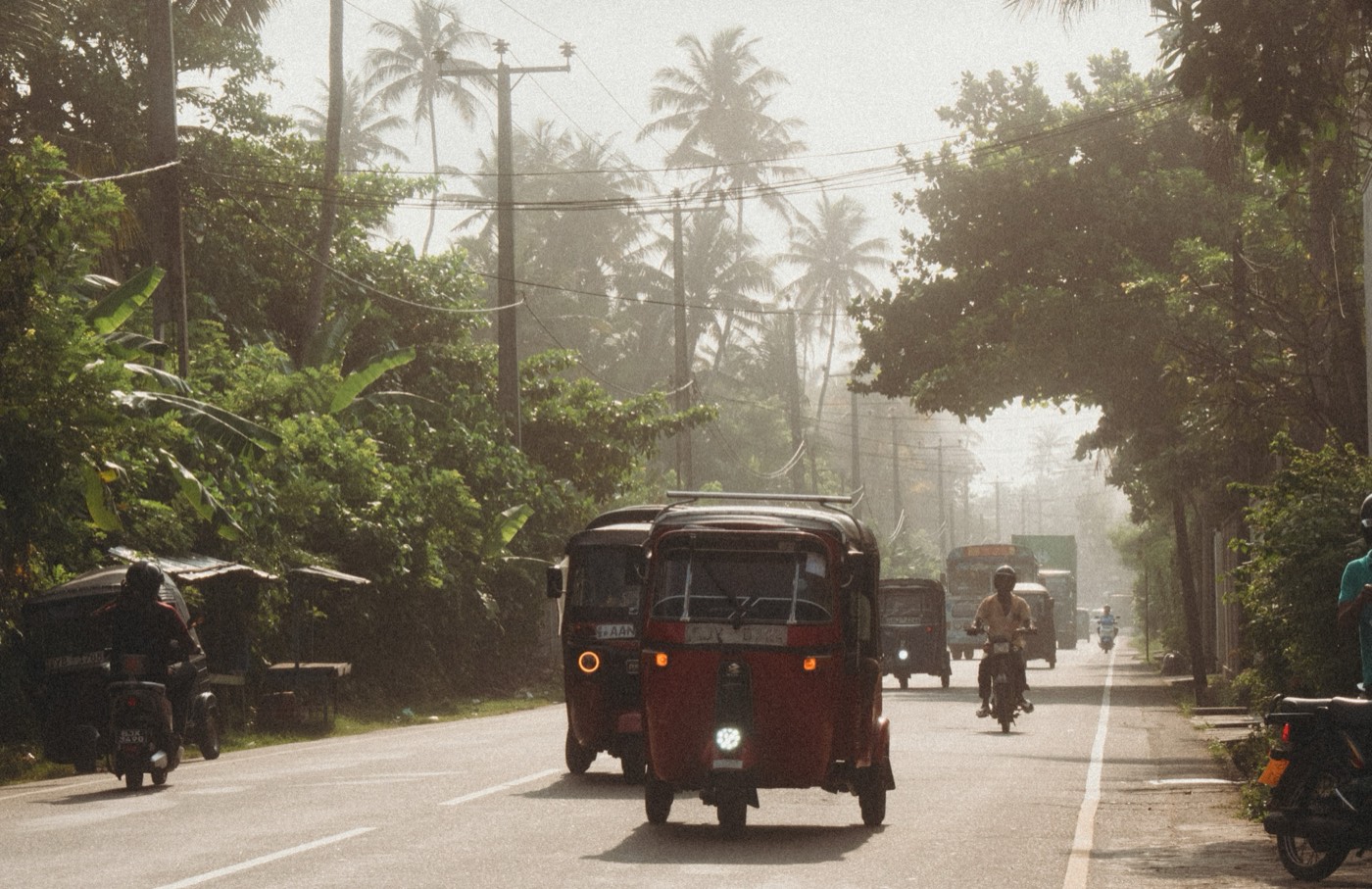
- Use the PickMe app for tuk tuks. It is the local ride-hailing app and gives you a fair, metered price so you skip the haggling. In smaller towns, agree a fare before you get in.
- Book scenic trains early, or ride unreserved. Reserved seats on the Kandy to Ella line sell out days ahead in season. If you miss them, unreserved second and third class are first-come, and the open doors are the best seat anyway.
- Watch the Poya days. Every full moon is a public holiday when alcohol is not sold and temples fill with pilgrims. Check the calendar so it does not catch you out.
- Carry cash. Guesthouses, tuk tuks and roadside food are often cash-only. Draw rupees in towns; ATMs are scarce in villages.
- Grab a SIM at the airport. A local Dialog or Mobitel SIM gives you cheap, fast data for maps and PickMe from the moment you land.
- Pack a warm layer. The coast is hot, but the hill country drops into single digits at night. First-timers always underpack for Nuwara Eliya and Adam's Peak.
- Mind the sea. South-coast currents can be strong. Swim at calmer bays like Unawatuna and Hiriketiya, and ask locals before you go in.
- The stilt fishermen are mostly posed now. Those iconic figures on poles near Koggala usually expect a tip for the photo, so agree a price first.
Follow this 10-day itinerary
This route works clockwise from the airport near Colombo and hits the highlights without doubling back. Stretch it to two weeks if you can.
| Days | Where | What to do |
|---|---|---|
| 1 to 2 | Sigiriya and Dambulla | Pidurangala at sunrise, Sigiriya after, the Dambulla caves, optional Polonnaruwa by bike. |
| 3 | Kandy | Temple of the Sacred Tooth for the evening puja, then board the hill-country train. |
| 4 to 5 | Ella and tea country | Nine Arch Bridge, Little Adam's Peak or Ella Rock, Lipton Seat or Diyaluma Falls. |
| 6 | Udawalawe or Yala | Early-morning safari en route to the coast. |
| 7 to 10 | South coast | Galle Fort, surf at Weligama or Hiriketiya, whale watching from Mirissa, a Koggala Lake boat safari, and slow beach or retreat days. |
Sort the practical basics
- Visa: most visitors need a 30-day Electronic Travel Authorisation (ETA), applied for online before you fly. Keep a copy of the approval.
- Getting around: trains for the scenery, tuk tuks for short hops, and a private driver for a few days to link longer routes without stress.
- Budget: Sri Lanka suits most budgets, from family guesthouses to boutique hotels, and food and transport are inexpensive by Western standards.
- Pace yourself: it is hot and humid, so save big activities for the morning and rest through the middle of the day.
Frequently asked questions
What are the top things to do in Sri Lanka?
The top things to do in Sri Lanka are climbing Sigiriya Rock Fortress, riding the Kandy to Ella train through the tea hills, going on safari in Yala or Udawalawe, watching blue whales off Mirissa, exploring Galle Fort, and relaxing or surfing on the south coast beaches like Weligama and Hiriketiya.
How many days do you need in Sri Lanka?
Ten days is enough for a strong first trip covering the Cultural Triangle, hill country and south coast. Two to three weeks lets you add the east coast, more time on safari, and slow beach or retreat days without rushing.
What is the best time to visit Sri Lanka?
For the south and west coasts and the hill country, visit from December to March. For the east coast, including Arugam Bay and Trincomalee, visit from May to September. The central Cultural Triangle works well most of the year.
Is Sri Lanka safe for tourists?
Sri Lanka is generally a safe and welcoming destination, including for solo travellers. Use normal travel sense, respect local customs at religious sites, choose reputable drivers and tour operators, and take care in the ocean where currents can be strong.
What are the best places to visit in Sri Lanka?
The best places to visit in Sri Lanka are Sigiriya, Kandy, Ella and the tea country, Galle and the south-coast beaches, and the national parks of Yala and Udawalawe. Add the east coast or Jaffna in the north if you have longer.
Final thoughts
The best things to do in Sri Lanka are not really a checklist. They are a rhythm: a dawn climb, a slow train, a plate of rice and curry, an afternoon in the sea, and enough space between it all to actually feel where you are. Use the map lists and local tips above to plan a route that flows through the four regions, and leave room to do nothing.
If you would like your trip to have a still centre, come and rest with us on the south coast. Join a yoga retreat for a few days or dedicate the whole journey to a yoga teacher training in Sri Lanka. Either way, you will leave with more than photos.