
Most people qualify by completing a 200-hour training, the recognised international entry standard. A full-time, in-person immersion takes three to four weeks. The same 200 hours spread across evenings, weekends or a self-paced online course takes two to twelve months. There is no exam board, licence or apprenticeship after that: once your certificate is issued you can register and begin teaching.
The number that confuses people is 200. It counts logged training hours, not calendar time, which is why two students holding an identical certificate can finish eleven months apart. Below is the realistic timeline for each level of qualification, a week-by-week look at what an immersive course actually fills those hours with, and the factors that stretch or compress the calendar. For the wider pathway — prerequisites, choosing a style, registering afterwards — see our companion guide on how to become a yoga instructor; for budgeting, see what a 200-hour course costs.
Hours, Not Weeks: Why the Same Course Takes 3 Weeks or 11 Months
Every entry-level qualification is measured in hours of study, and a registered syllabus has to distribute those hours across set categories. For a 200-hour programme the split is roughly:
- ~75 hours — techniques, training and practice: asana, pranayama, meditation, the postures themselves.
- ~30 hours — anatomy and physiology, both biomechanical and energetic.
- ~30 hours — yoga humanities: history, philosophy, ethics, including the eight limbs of yoga.
- ~50 hours — professional essentials: teaching methodology, practicum, and the practicalities of working as a teacher.
- ~15 hours — electives, allocated at the school's discretion.
Schools vary in how they weight these, but the total is fixed. So the timeline is simple arithmetic: 200 divided by the hours you can commit each week. Forty hours a week finishes in five weeks. Ten hours a week takes five months. Three hours a week takes well over a year.
200 is a number of hours, not a number of weeks. The format you choose is what turns those hours into a timeline.
Timelines at a Glance
Here is how the common levels of qualification compare, assuming you complete each one in sequence.
| Level | Full-Time | Part-Time / Online | What It's For |
|---|---|---|---|
| 100-hour foundation | 10–15 days | 1–3 months | An introduction; often a stepping stone toward the 200-hour. |
| 200-hour (RYT 200) | 3–4 weeks | 2–12 months | The standard entry qualification to start teaching. |
| 300-hour advanced | 4–6 weeks | 4–12 months | Deepens your skills after the 200-hour. |
| 500-hour (200 + 300) | 7–10 weeks | 6 months–2 years | Combined total, usually with teaching experience in between. |
What Three to Four Weeks Actually Looks Like
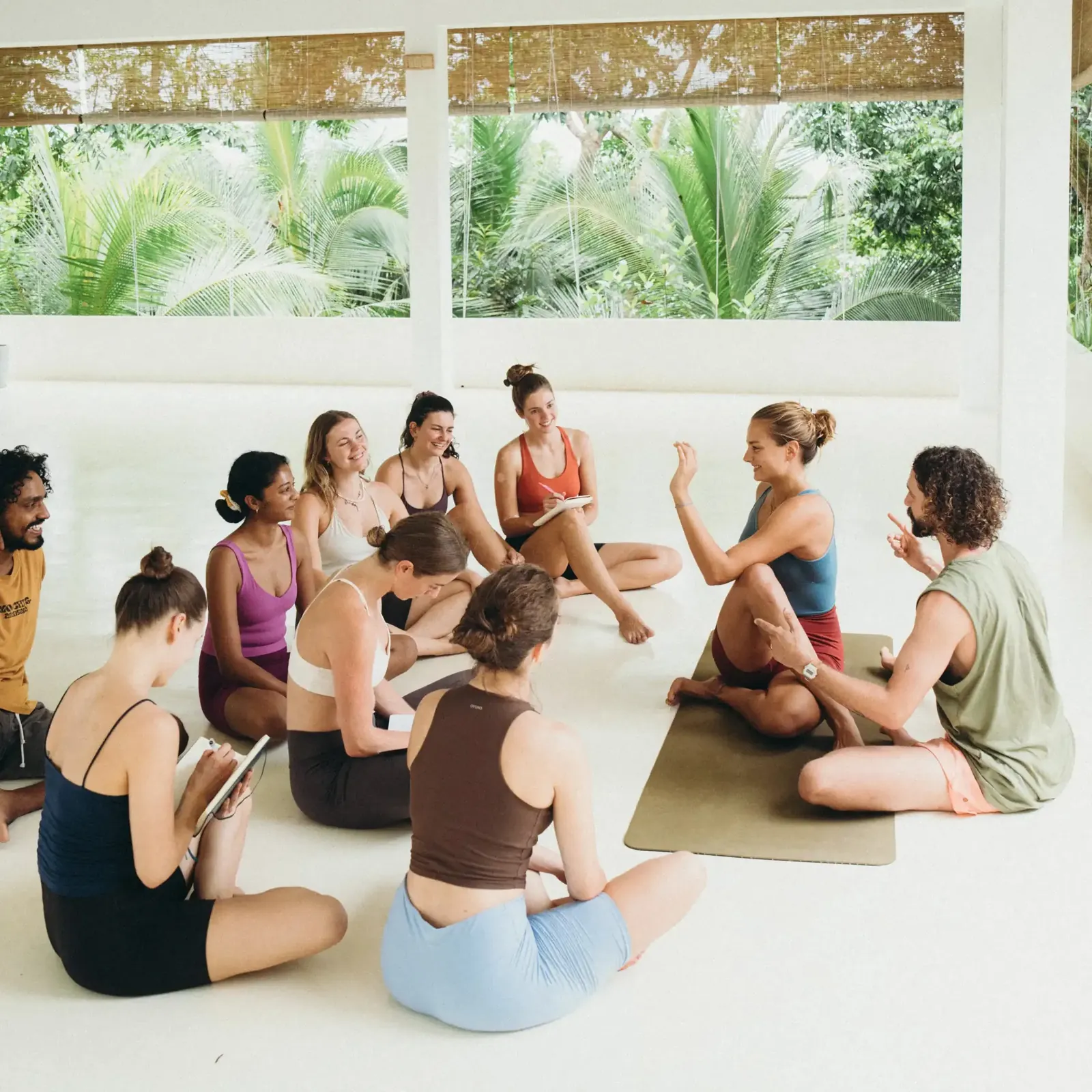
Three weeks sounds impossibly short until you see the daily load. An immersive course typically runs six days a week at eight to ten hours a day — practice before breakfast, theory through the middle of the day, a second practice or teaching lab in the late afternoon. Six days across four weeks at nine hours a day is roughly 216 hours, comfortably clearing the requirement. A three-week version reaches the same total by running longer days with fewer rest days.
The shape of those weeks is fairly consistent from school to school:
- Week one: your own practice, foundational postures broken down, and the vocabulary you will teach with.
- Week two: anatomy, biomechanics, and the beginnings of sequencing — how postures connect into a class.
- Week three: philosophy and ethics, hands-on and verbal adjustments, and your first short teaching slots in front of peers.
- Week four: full practicum, assessment, and the working realities of the job — insurance, class planning, finding your first students.
The compression is the point. Removing commutes, work and admin from the equation is what makes a month enough; it is also why immersive students often report more retained a year later than they expected.
What Changes Your Timeline
Two people can enrol in courses of identical length and finish months apart. These are the factors that make the biggest difference:
Format and schedule
This is the single largest variable. An immersion removes daily distractions and packs the hours into consecutive days, which is why three to four weeks is realistic. A part-time course respects your existing commitments but naturally stretches the calendar, often to twice or three times the length anyone plans for at enrolment.
Your weekly availability
For self-paced online programmes, the maths above is the whole answer. Be honest about the hours you will actually protect each week rather than the hours you hope to find — the gap between the two is the most common reason a "six-month" course takes a year.
Your starting experience
You do not need years of advanced practice to train, but a settled personal practice means less time spent getting comfortable with alignment and basic postures, and more time absorbing teaching skills. Around six months of regular practice beforehand is a comfortable — not compulsory — baseline.
Live contact-hour requirements
Registered schools must meet minimum standards, including a set number of live, contact hours for online courses. A programme offering only one or two live calls a week will, by design, take longer to complete than one with a dense weekly schedule, regardless of how quickly you work through the recorded material.
Assessment and make-up sessions
Most courses require a minimum attendance and a passing practicum. Missing sessions through illness or travel usually means scheduling make-ups, which on a part-time course can add weeks — and on an immersion may mean completing remotely afterwards.
Do You Need to Practise for Years First?
This is the worry that holds many students back, and it is largely a myth. There is no universal rule that you must practise for a set number of years before training. What genuinely matters is a consistent practice that has given you a good understanding of yoga. Plenty of excellent teachers trained within a year or two of their first class. Communication, attentiveness and care for your students outweigh time on the mat. Great teaching also requires an understanding of the body, respect for individual anatomical and medical differences, and the ability to adapt practice to the person in front of you.
How Long Until You're Actually Teaching Well?
Certification and confidence are not the same thing. The moment your course ends you are qualified to teach beginner-level classes, and many graduates teach their first public class within a few weeks — community classes, friends, a covering slot at a local studio. Fluency is a different timeline. Most teachers describe the shift from reciting a plan to genuinely reading a room as arriving somewhere between fifty and a hundred classes taught, which for someone teaching two or three times a week is six months to a year.
Building enough regular classes to make teaching a primary income typically takes longer still — one to two years in most markets. Worth factoring in if your question about timelines is really a question about when this becomes a career.
After the First Certificate: 300 and 500 Hours
A 300-hour advanced qualification takes about four to six weeks full-time, or four to twelve months part-time. Completing it on top of your 200-hour brings you to the 500-hour level. Schools generally recommend teaching for a year or two in between rather than stacking the two back to back, so the realistic 200-to-500 journey is two to three years even though the study time itself is only seven to ten weeks. Specialisms — prenatal, yin, trauma-informed, children's yoga — usually run twenty to a hundred hours each and slot in alongside.
The Honest Bottom Line
If your goal is to be certified and teaching as efficiently as possible, the answer is roughly three to four weeks of full immersion in a quality 200-hour course. If you need flexibility around work and family, give yourself a realistic window of a few months to a year, and add a margin to whatever the brochure says. Beyond that, becoming a yoga teacher is less an endpoint than an ongoing practice: the certificate is the starting line, not the finish. And if you can't clear three weeks yet, a shorter week on one of our week-long yoga retreats in Sri Lanka is a reasonable way to build the practice a training will ask for.
Frequently Asked Questions
How long does it take to become a yoga teacher?
Most people qualify by completing a 200-hour course. An intensive in-person immersion takes about three to four weeks full-time, while part-time and online formats take two to twelve months. You can begin teaching as soon as you are certified.
How long is a 200-hour yoga qualification?
It requires 200 logged hours of study. Full-time immersive courses fit this into roughly three to four weeks by running eight to ten hours a day, six days a week; part-time and self-paced programmes spread the same hours across two to twelve months depending on your weekly availability.
How many hours a week does a part-time course need?
Divide 200 by the weeks you have. Ten hours a week finishes in about five months, five hours a week in ten months, and three hours a week takes over a year. Most part-time schedules ask for one weekday evening plus one full weekend day.
How long does it take to get a 300-hour or 500-hour certification?
A 300-hour advanced qualification takes about four to six weeks full-time, or several months part-time, and follows your 200-hour. Completing both reaches the 500-hour level — seven to ten weeks of study time, but usually two to three years in practice because schools recommend teaching in between.
Can you become a certified yoga teacher in a month?
Yes. A full-time immersive 200-hour course can be completed in three to four weeks, the fastest realistic route. After finishing you can register as an RYT and start teaching beginner-level classes.
How long before you can teach confidently?
You are qualified immediately, and many graduates teach their first public class within weeks. Genuine fluency tends to arrive after fifty to a hundred classes taught — roughly six months to a year at two or three classes a week.